
Industrial Telemetry Troubleshooting
Investigate intermittent communications, missing updates, and readings that disagree across your system. We focus on one defined fault and record what the evidence supports.
A focused investigation.
A written record.
Share the affected system, symptoms, and previous checks. We agree the diagnostic approach, access, price, and reporting needs before paid work begins.
- A defined fault and investigation boundary
- Recorded observations, relevant evidence, and known limits
- Recommended next tests or corrective actions for your authorized team
Problems we can investigate
- Intermittent Modbus or serial communications
- Devices that stop updating under particular operating conditions
- Missing replies, retries, or errors in available communications records
- Gateway and protocol-conversion discrepancies
- Values that differ between an instrument, controller, and SCADA display
- Unexpected scaling, engineering units, or timestamps
- Gaps between a data source and its historian or dashboard
We confirm the supported interfaces, necessary equipment, and permitted capture or test method during scoping. A symptom alone does not establish whether the cause is a device, connection, configuration, or application.
Clear working boundaries
- PLC programming and control or configuration changes are excluded.
- We do not operate, energize, or restart your equipment.
- Electrical installation, repairs, hardware supply, and system integration are excluded.
- Any intrusive test requires an agreed method and your authorization.
- Corrective work remains with your authorized team or chosen contractor.
For a broader record of one measurement path, including a path diagram and report review, see the Data-Path Health Check.
Plan around the intermittent fault
A fault may not occur during a single visit. Its frequency and operating conditions help determine a useful observation period.
We record what was observed and what remains unresolved. Where longer observation would help, we define the access, collection method, duration, and deliverables before additional work.
Support alongside your team
We work with manufacturing maintenance and engineering teams and can provide scoped diagnostic support to systems integrators.
On-site work is available across Saint Paul, Minneapolis, and the Twin Cities, with other Minnesota visits by arrangement. This is scheduled diagnostic work; emergency response and continuous monitoring are not included.
Finding an intermittent pattern over 14 days
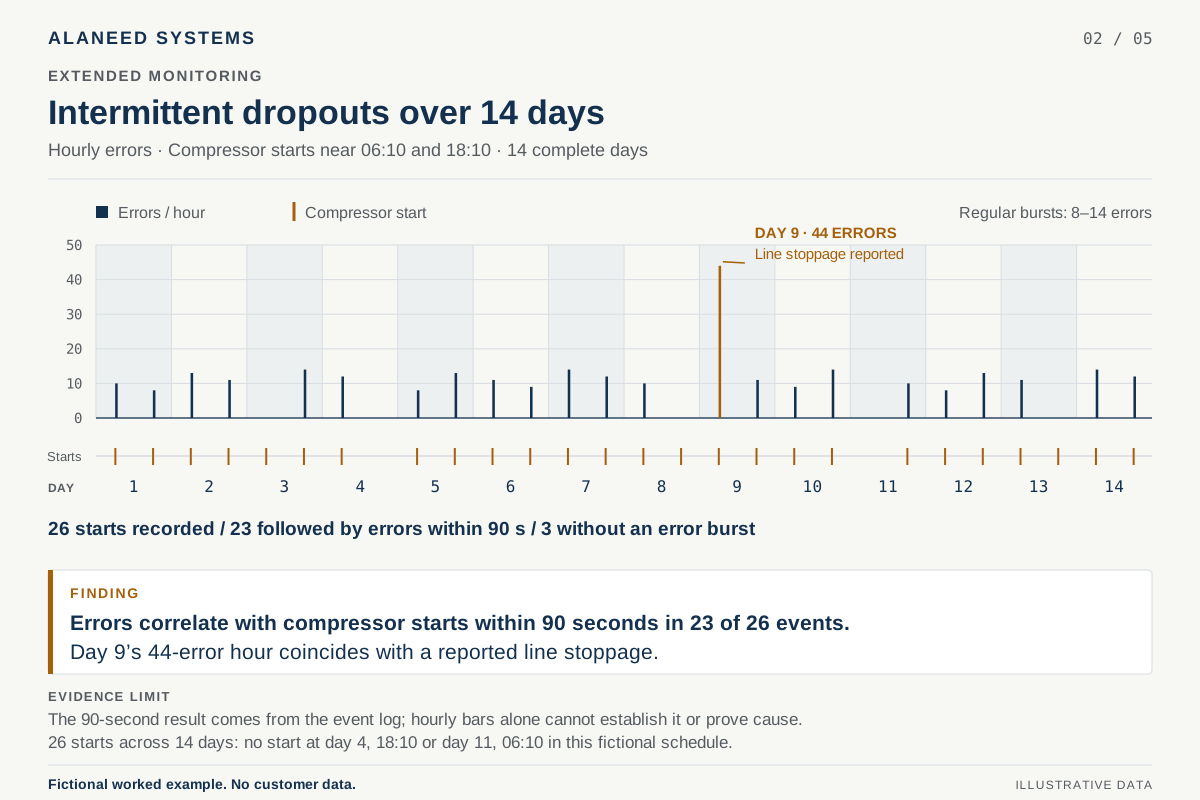
Fictional worked example. No customer data.
Finding: Errors correlate with compressor starts within 90 seconds in 23 of 26 events. Day 9’s 44-error hour coincides with a reported line stoppage.
Evidence limit: The 90-second result comes from the event log; hourly bars alone cannot establish it or prove cause. 26 starts across 14 days: no start at day 4, 18:10 or day 11, 06:10 in this fictional schedule.
View the full-size exampleLocating unanswered Modbus polls
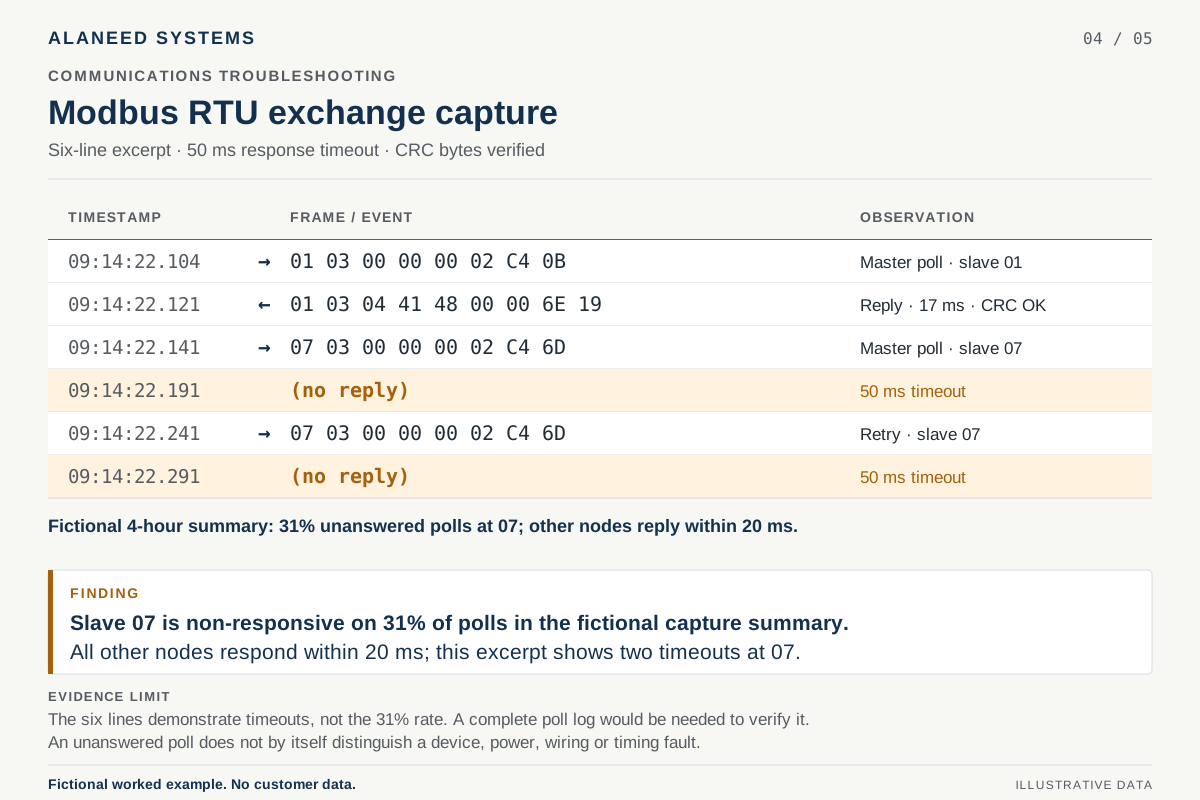
Fictional worked example. No customer data.
Finding: Slave 07 is non-responsive on 31% of polls in the fictional capture summary. All other nodes respond within 20 ms; this excerpt shows two timeouts at 07.
Evidence limit: The six lines demonstrate timeouts, not the 31% rate. A complete poll log would be needed to verify it. An unanswered poll does not by itself distinguish a device, power, wiring or timing fault.
View the full-size exampleTell us what stops working.
Include the affected device or data path, when the fault occurs, any previous checks, and the site location. We will review the fit and scope the investigation.