
Legacy Telemetry Documentation
Recover a usable record of an existing telemetry system when drawings are incomplete, settings are scattered, or the person who understood it has left. Give your maintenance team and integrator a shared starting point.
What the record can include
- An equipment inventory: role, model, address, protocol, and readable firmware or software version
- A connection and topology diagram for the agreed system boundary
- Accessible cable routes, gateway relationships, and data destinations
- Available communications settings and device dependencies
- Photographs of relevant assets, where your site permits them
- Differences between existing records and observed conditions
- Support or obsolescence information, with its source and any uncertainty
- Missing information, unresolved risks, and prioritized next steps
Each record distinguishes what we observed from what was supplied, inferred, or could not be verified. Restricted access and missing source files are recorded as gaps.
Make the next decision easier
A usable system map helps your team locate dependencies, prepare maintenance, and explain the installation to a new contractor.
It can also support a staged modernization plan. Your team and integrator can use the same inventory and topology to evaluate what to retain, investigate, or replace.
For a specific recurring fault, add a separately defined troubleshooting investigation. Documentation alone does not establish electrical condition, signal quality, or the cause of an intermittent problem.
A legacy network, as found
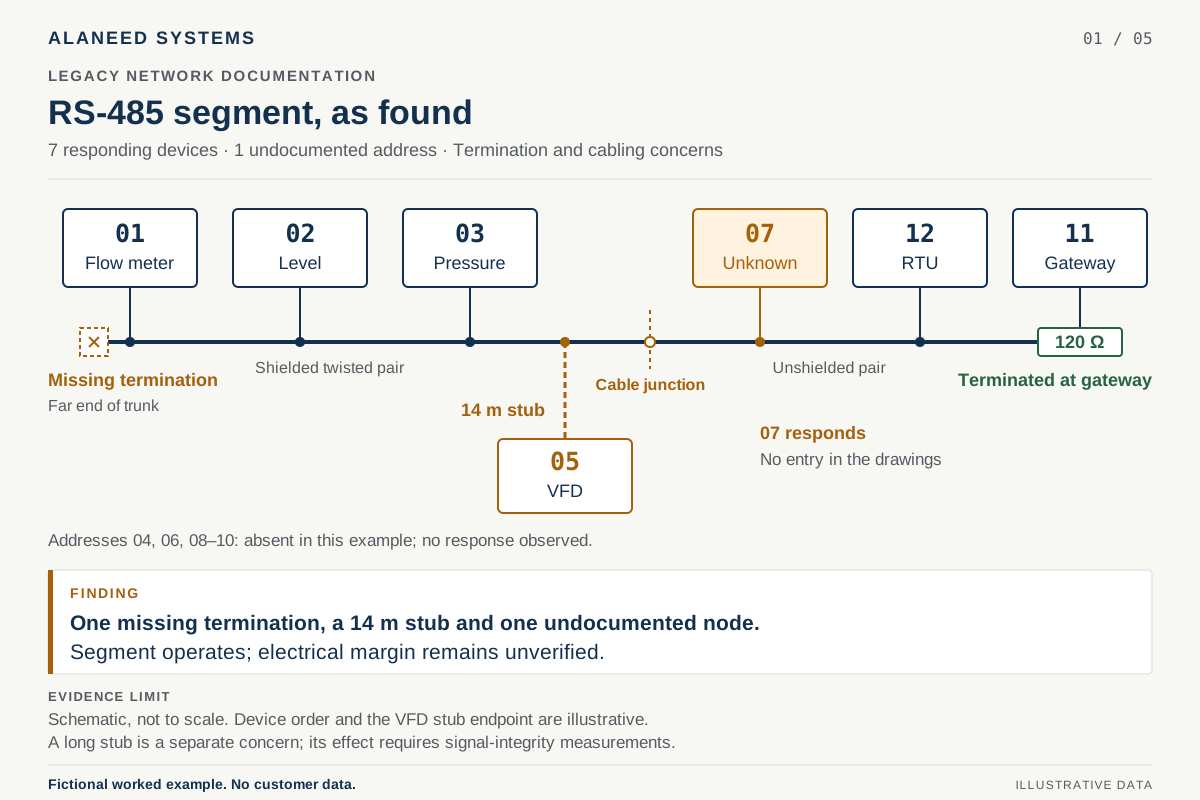
Fictional worked example. No customer data.
Finding: One missing termination, a 14 m stub and one undocumented node. Segment operates; electrical margin remains unverified.
Evidence limit: Schematic, not to scale. Device order and the VFD stub endpoint are illustrative. A long stub is a separate concern; its effect requires signal-integrity measurements.
View the full-size exampleScope and deliverables
- Project boundary
- We agree the devices, network segments, available records, and site access before work begins. Start with one machine, line, or telemetry segment if the wider installation is not yet understood.
- Written agreement
- Your quote defines the inventory and diagrams to be delivered, document formats, any permitted testing, the price, and the delivery schedule.
- Your deliverable
- A documentation package covering the agreed inventory, topology, dependencies, evidence sources, known gaps, and recommended next actions.
- Useful triggers
- A maintenance handover, missing drawings, an unsupported gateway, a change of integrator, or planning for an equipment upgrade.
- Working boundaries
- PLC programming, control or configuration changes, electrical installation, repairs, hardware supply, and system integration are excluded. We document findings for the team responsible for corrective work.
- On-site service
- Saint Paul, Minneapolis, and the Twin Cities. Other Minnesota locations by arrangement.
Start with the records you have.
Old drawings, model numbers, screenshots, and staff knowledge can all help define the work. They do not need to be complete. We agree what can be recovered and identify what requires further access or investigation.
If your first priority is understanding a single measurement discrepancy, the Data-Path Health Check may be a better starting point.
Give your team a usable system map.
Tell us which installation needs documenting, what records exist, and where it is located. We will prepare a defined scope for the documentation work.